Friday, April 10, 2015

Anti-Federalists


Art by - Grunuffy @ deviantart.com
There are many different aspects and concepts that you'd have to face while making a Federalist government. One of the greatest fears is that the greater officer in the Republic may start being idolized and viewed a more than the average colonists. By doing so, these officers may start taking more control and abusing their power. Another bad thing about having a small group of legislatures is that the small amounts will most likely lead to corruption, bribery may occur between states. This will also make the little confidence in the government that the people might have even smaller. To gain the encouragement and the affection of the people, the government may have to resort to force.  Lastly, diversity will be one of the largest problems in this type of government system. Everybody is from different regions of the nation which all have their own unique way of interpreting the situation. This will most likely cause the government to never be able to agree on anything. Lastly some states may be ignored or not valued as highly as other states as stated by The Federal Farmer (Henry Richard Lee) on October 9th, 1787 
"The essential parts of a free and good government are a full and equal representation of the people on the legislature"
Smaller and less wealthy states might be put down by the larger states that have more power and wealth. 

Citations 

Image - Anti-Federalist. Digital image. Deviantart.com. DeviantArt, 2012. Web. 3 May 2015. 
Quote - Lee, Henry R. "The Federal Farmer (Henry Richard Lee) No.2." Federal Farmer. 9 Oct. 1787. Web. 3 May 2015.

Tuesday, February 10, 2015

Voices of the Revolution


Statement: "Before 1779 the reason's for an individual's support for or opposition to independence were primarily economic."

Though there was quite a lot of talk about how this major decision of support against or for the British was solely economic, we also must think about the other factors when it came to making this choice. You can take Charles Inglis as a fair example. Charles Inglis, a colonist none the less, thought heavily and thoroughly upon this matter in his article "Charles Inglis The True Intrest of America Impartially Stated in 1776" and had came to the conclusion that it would be an unwise option to separate from Britain. 

In his article he describes the pros and cons of reconciling with Britain and all of his counterargument were all based on one key foundation - peace. He describes peace to be "...like health; we do not sufficiently know its value but by it's absence," (Charles Inglis). He says that if we stay with the British, our agriculture, commerce, and industry would continue on at a regular pace, but not only that, we'll also have the largest naval power in the world. The cheap imported good galore, what's not to love? He also rightfully said nearing the ending that even if we have the French military by our side, the French have already made peace with the British - who are we to say if they are going to help us or not?        

Sources

Picture - 
We the People. Digital image. Voice the Planet. Stuart L. Hart., n.d. Web. 09 Feb. 2015.
Information - 
Inglis, Charles. "Charles Iglis The True Interest of America Impartiality Stated in 1776." (1776): 1-4. Web. 10 Feb. 2015.

Monday, February 2, 2015

Letter to John Locke

Dear Sir Locke,

I am just a humble writer and was asked to write the document in which we are to declare independence against the British. I have been a large follower of your works for ages now and have decided to use your winged words in this document. One of the major examples may be your concept of the functioning government. As I recall, the functioning government must ensure the rights of life, liberty, and the pursuit of happiness for the people - which I mention extensively. I also added to the document that if the government fails to meet these basic requirements, then it mandatory for the people to take a stand and assemble a different government. Thank you once again.

Sincerly,
Thomas Jefferson

Thursday, October 30, 2014

Response to the Salem Witch Trials


Hello! My name is Thomas Carpenter, the grandson of Robert Carpenter - the merchant was able to thrive and survive as, at first a poorly wood whittler, then later traveled up to Boston and accepted a puritan way of life. My parents later moved on Salem where I now live, silently watching the mass hysteria unfold. Although I do try my best to attend meetings about the so-called "witch trials", I'd rather stay out of it just to make sure I do not become consumed by it. I am extremely terrified for the little girls who were bewitched, but a little bird in the back of mind sings to me saying that maybe this isn't something what I should at all be worried about. What if the town is getting all worked up for nothing. But I really don't want myself to seem as if I do not believe that the devil is in Salem. If I make it seem that way, then people will suspect something. Just because I am not foolishly turning my head accordingly towards the bait the fishermen are stringing, that would not make me a witch (or wizard). But in the society in which I live in, any act of uniqueness will most definitely have you branded, and will mostly likely make you a suspect for the trials.      


Well, if you would even like to call them trials. This hysteria began with three little girls for the Lord's sake. It would be completely logical to think that the girls just carried this on to just gain attention. But then you also have to think about that pesky slave girl, Tituba. She did seem a bit off when I first saw her, but I just assumed it was because she was of a different country all together. But what if she did teach the girls witchcraft? I'm not saying that I believe in witchcraft, but I always keep an open mind about things. If the devil is real, why can't witchcraft be as well? The thing that really makes me afraid of the trials is not the possibility of witchcraft being real. No, it's much worse than that. My fear is that we'll all just try and kill each other to the end, filled with so much paranoia in our systems that we'll just be corpses of the well and civilized people we once were. Any ways, it was nice writing all of my thoughts down in pen. Helped me clear up my mind from all the hysterics for once. Well, that is all for now. I'll be sure to keep you updated on the trials as they move along. Good day.        

Monday, October 27, 2014

Do you feel that Anne Hutchinson received a fair trial by the standards of life in the 1630's? Explain why or why not, cite examples from the trial that support your answer.


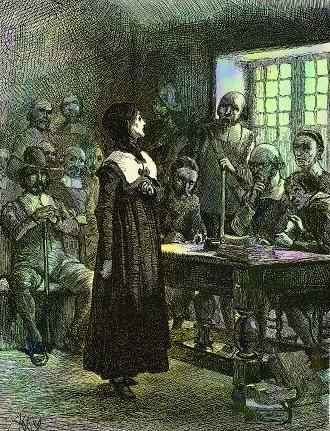
During that time and era, women (in general) were persecuted and forced to hide in the shadows. The church had laws that said women were ought to be silenced and not let them speak in church. So when suddenly a headstrong woman, such as Anne Hutchinson comes along, taking trials and raising an uproar within the community - you can already assume that every single man in the church room will be skeptical about her whole scheme. But what really got to me was the fact that the church didn't want to hold the trial under an oath. Doesn't anything in particular seem sketchy to you? Anne brought up a reasonable point "If they accuse me, I desire to be upon an oath." And who wouldn't be? I wouldn't want any lies or mishaps going around the trial room. Also, personally, it felt like the governor was just intent upon killing her or banishing her. So he knew that either way, she'll be banished or tormented. He tried everything within his power to not let her win, and he was successful in doing so. 

Picture:    NA. Anne Hutchinson. N.d. NA, NA. Equal Visibility Everywhere. Web. 28 Oct. 2014.

If you were a member of the church that was tasked with casting a vote for the guilty or not guilty, what would have your vote been? Explain your choice and cite examples from the trial to support your answer.


If I were a member of the church and was asked to cast a vote to whether or not Mrs. Anne Hutchinson should be convicted guilty, I would reply saying that she was innocent - although that would have been an entirely different thought that what everyone else in that room was thinking. But I have several different reasons for why I think she is innocent. Even though she has some very supercilious and bold thoughts about herself (saying that she is a messenger of God) and also saying that the church members are all not certified to be "saved" thus, they should not be a church member (even I would say that that is going too far), but she also stated some very key pieces of evidence in order to prove herself innocent. One thing that she discussed was the passage from the Titus "that the elder woman must instruct the younger," which I found to be quite a smart move on her part. It certainly got me believing she was innocent, even for a moment. But then the Governor brought up the rules of the Corinthians and I suddenly felt very conflicted. Thinking logically, if I were alive during this time period and especially a male, I'd feel the need to stand up and support the Corinthians. But thinking about this whole situation from a modern point of view, I feel the need to say that the woman is only speaking her thoughts. Free speech, that is a huge thing that we can find in our modern laws. Another thing that I also realized was true was Mrs. Hutchinson's argument of the covenant of grace versus the covenant of works. The church is preaching that if you are a good citizen and are well mannered and have proper etiquette, then you are probably saved. Basically, the church is preaching the covenant of works is the way to go. But technically, the actual puritan faith is based around the fact that whether we are saved does not depend on our actions, but from the predetermining grace that God has set upon you, reassuring you are saved.

Picture: Gun, Thomas. Anne Hutchinson on Trial . N.d. NA, NA. Wikipedia. Web. 27 Oct. 2014.       

Monday, October 6, 2014

Send to: Susan Carpenter

Robert Carpenter 
May 27th, 1607
At the coast of the Virginia Colonies

We Made It!


Source: howstuffworks.com

Dear Susan, 

After months of traveling in a that horrid thing that we call a "ship", eating terrible food with unknown items mixed into it (I shudder at the thought of it), and passing the time by whittling, learning how to properly read and write from Timothy, and working as a we finally made it to the New World. After so many hardships, we finally made it! But I am not all that sure if I should start celebrating or not. Out of the 144 people who went aboard on the Susan Constant, Discovery, and the Godspeed, nearly 39 people died. That gave us only 105 survivors left to tread this land. And thankfully, I was one of the survivors. 

And just so if you felt worried dear on why I didn't write to you every single day or week, this was because I didn't want to worry you. I only wanted to send you the letters only if something big had happened. But I still did write to you, I have pages and pages of letters that I never sent to you because I just thought they were too pointless, frivolous or boring. I still wrote them anyways. Fine, you can now laugh at me and my silly romantics. But mind you Susan, I spent many hours trying to create this story.

Well anyways, when we first came to our settlement (a few weeks back), it was marshy and quite different than the land of England that we had journeyed from. Really, there were no people in sight. The reason why we even chose to settle in such a wasteland was to avoid Spanish ships from coming. We managed to keep away from them, for now. 

Now, the first weeks of our settlement were peaceful. It was just us trying to build a place where we can live and prosper. But then the Indians came. They seemed nice at first, but then they got angry. They got angry at us for taking their land. I mean, I would be angry as well if someone took my home, but the councilmen were not looking at what was just. They were seeing this land as if it was all their's the own and keep. We settlers were the only right that can be seen through all the wrongs that everyone else was doing. And I guess that was wrong.

Anyways, we managed to come to a mutual agreement with the Indians and their chief Powhatan. We trade English items such as guns, alcohol, and etc with them, and in return they traded corn, beans, and growing and fishing techniques with us. It is a pretty good system, but I am honestly not sure how long this "peaceful" relationship will last between us.  
Alright, this is all I have for you now. Hope to see you soon!

With much love,
Robert